


Playhouses: How to Choose the Right Backyard Fit
The best backyard play space isn’t necessarily the one with the most features. It’s the one that makes room for the kind of play your family enjoys. Choosing among playhouses can feel tricky when you’re weighing imaginative role-play against climbing, swinging, and sliding, while also trying to preserve useful open space in your yard.
Start with how children are likely to use the structure and how it will fit into the yard. A compact playhouse can create a setting for make-believe, while a larger playground set invites more active play and takes up a greater share of the outdoor space. Neither is automatically the better choice. The right fit depends on your family’s routines and priorities.
This guide compares practical features and yard considerations to help you decide. Ever Yard Co.’s collection includes two wooden playhouses with distinct imaginative-play features, alongside an elevated playground set with a clubhouse, balcony, swings, and slide. We’ll look at the play each option encourages, what to consider when planning its location, and how to move from browsing to a confident choice.
Key Takeaways
- Start with the kind of outdoor play you want to encourage before comparing features or structure size.
- Choose features for the play they support, not simply because they’re included.
- Compare the three playhouse and playground options by format, listed features, and the play styles they suggest.
- Measure the yard and map access before settling on a location for the play structure.
- Match your preferred play style to the collection, then compare product details with your space and family routines.
Playhouses: Start With the Kind of Backyard Play You Want to Create
A backyard playhouse gives children a dedicated setting for imaginative, social, or active play. Some are simple, house-like spaces for pretend routines. Others are part of a larger playground set with elevated and moving-play elements. A playhouse centers play around a sheltered pretend space; a playground set adds activities such as climbing, swinging, or sliding. Neither format is inherently better. The right choice depends on the play you want to make room for.
Decide on the type of play before comparing accessories, appearance, or size. A feature adds value when it supports activities children are likely to return to, not just because it appears in a product description. For a broader look at how the word is used, see History and Definition of Playhouses. For a backyard choice, focus on how the structure will serve your family outdoors.
Match the structure to the play children return to
Think about what children do when they have time and space to invent their own games. A house-shaped play space can become a shop, a home, a clubhouse, or a setting for stories shared with siblings and friends. A play kitchen supports familiar pretend routines, while a service station can inspire games about serving customers, organizing supplies, or welcoming visitors. These features give imagination a starting point without dictating the whole story.
Active play has a different rhythm. An elevated clubhouse, balcony, web swing, swing set, and wave slide invite children to move between places and activities. Consider whether your family is drawn more to role-play, shared movement, or a mix of both. Think about solo play as well as group play: a child may enjoy tending a pretend kitchen alone, while a swing or clubhouse can become a natural gathering point. Interests change, so choose for the routines you can picture returning, not only the excitement of a first look.
Think about the yard as part of the play experience
The structure is only one part of the setting. Account for the usable space around it, including the approach children will take, where play may spill outward, and whether other backyard routines need room to continue. A structure can fit on paper yet feel crowded if it interrupts a path, occupies the main gathering area, or leaves little room to move around it.
Look at the proposed location from the rooms where adults spend time. Clear sightlines from the home can make everyday supervision more practical and help the play area feel connected to family life. Notice what might block the view, and consider how children will move between the house, play structure, and other parts of the yard. Before choosing a format, picture a typical afternoon: where children will gather, how they’ll use the space, and whether the yard will still work for everyone else. That’s a more useful starting point than choosing by accessories alone.
How to Compare Playhouse Features Without Losing Sight of Fit
A useful comparison starts with four questions: What kind of play does the structure invite? Which listed features support that play? Is it a house-style playhouse or a larger set? And how will it work in the yard day to day? These questions keep a long feature list from becoming the decision itself. Extra details matter when children are likely to use them, not simply because they appear in a product description.
Compare features by the activities they support
Doors and windows can help children set a scene, welcome visitors, or move between pretend roles. A bench offers a place to pause or share a story, while a service station or play kitchen can give role-play a familiar focus. These features may encourage children to invent together or return to a favorite scenario on their own.
Other elements point toward movement. A balcony or elevated area creates a different kind of play space; swings and slides invite children to move through the yard. Compare the whole format, too: a house-style structure centers play around an enclosed setting, while a larger playground set combines a clubhouse with active-play elements. Don’t assume that more features mean a better fit, or infer capacity, durability, or safety from a feature name alone.
Review product details separately. Check the specific listing for materials, dimensions, and age recommendations rather than relying on general expectations about playhouses. The CPSC’s Playground Safety Handbook offers guidance for public playgrounds. It isn’t a product-specific guide for backyard playhouses, so use the manufacturer’s instructions for the particular structure.
Consider footprint, access, and everyday supervision
Compare verified product dimensions with the actual placement area, then consider the space children will use around the structure. A slide or swing changes how the area functions, so the footprint alone may not show whether the play zone will feel workable. Think through routes from the house and across the yard, as well as the view from rooms where adults spend time. Clear sightlines can make everyday supervision feel more natural.
Use this checklist as you review each option:
- Play: Which regular activity does the structure support?
- Features: Which listed details will children actually use?
- Format: Does a house-style space or a larger set better suit the routine?
- Fit: Do verified dimensions and the surrounding play area work in the intended location?
- Details: Have you reviewed product-specific materials, age guidance, and instructions?
With those criteria in view, explore the playhouse collection and compare each option with your space and the play you want to encourage.
Three Playhouse Collection Options, Compared by Play Style
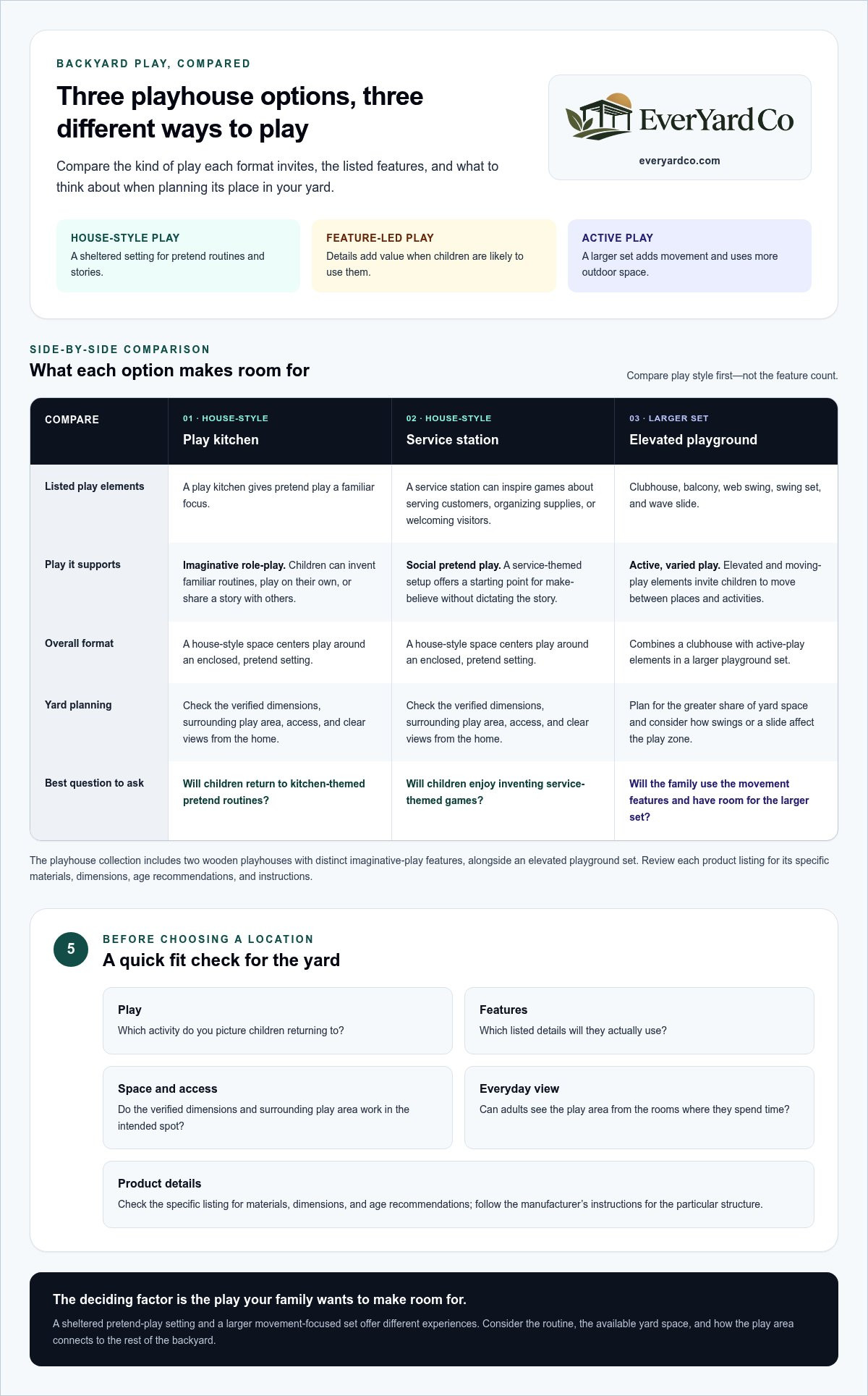
A product name tells you what a structure includes, but the useful comparison is what those features invite children to do. The collection presents three formats: two wooden playhouses centered on pretend scenarios and an elevated playground set with several active-play elements. The table summarizes the listed features without making assumptions about dimensions or performance.
| Product format | Named features | Play style suggested |
|---|---|---|
| Wooden Kids Indoor, Outdoor Wood Playhouse with Working Door, Windows, Bench, Service Station, Flowers Pot Holder | Working door, windows, bench, service station, flowerpot holder | Imaginative role-play and storytelling organized around a service-station setting |
| Wooden Kids Playhouse with Play Kitchen, Half Door Windows, Flowerpot Holders, Toys Playset for Backyard Play (Brown and Grey) | Play kitchen, half door, windows, flowerpot holders | Pretend kitchen routines and imaginative play |
| Outdoor Playground Set W/ Elevated Clubhouse, Balcony, Web Swing, Swing Set, and Green Wave Slide | Elevated clubhouse, balcony, web swing, swing set, wave slide | A mix of elevated play and movement between active-play features |
Wooden playhouses for imaginative role-play
The first wooden option brings together a working door, windows, bench, service station, and flowerpot holder. The service-station detail gives pretend play a clear starting point: children might invent a place to welcome visitors, while the bench and windows become part of the setting for their stories. The listing also names a flowerpot holder, another detail children can bring into their play.
The second wooden option centers on a play kitchen, with a half door, windows, and flowerpot holders also named. Compared with the service-station feature, the kitchen suggests familiar pretend routines such as preparing and serving food. Both listings support imaginative play, but their distinguishing features offer different prompts for children’s stories. Consider which scenario is more likely to draw your family into repeat play.
An elevated clubhouse and active-play alternative
The Outdoor Playground Set W/ Elevated Clubhouse, Balcony, Web Swing, Swing Set, and Green Wave Slide combines a clubhouse and balcony with a web swing, swing set, and wave slide. Those named features make it a different format from the two wooden playhouses, which focus on house-style role-play. Consider whether the mix of elevated and moving-play elements suits the activities you want to make room for, and whether your yard has space for the structure and its play area.
The best fit depends on the play your family prefers and the space your yard can comfortably give it. Before deciding, compare each product’s verified dimensions with your intended placement area, and review its manufacturer guidance, including any age recommendations and instructions. The listing features help narrow the play style; product-specific details help you judge how each option fits your yard and family routines.
Plan the Playhouse Location and Avoid Common Buying Mistakes
A product photo can show a playhouse in an inviting setting, but it can’t tell you whether the structure will work in your yard. Plan the location before settling on a favorite. Consider the space children will use around it, how they’ll reach it, and whether the play area will remain visible and comfortable as part of everyday life.
Use this sequence to make the decision more practical:
- Measure: Compare the product’s verified dimensions with the proposed site, allowing for any clearance stated in the manufacturer’s instructions.
- Map access: Trace children’s routes to the play area and note nearby paths, doors, windows, fences, and places adults commonly spend time.
- Review instructions: Read the specific product’s assembly, anchoring, age, and placement guidance before deciding where it belongs.
- Confirm the play zone: Picture the structure in use, including the surrounding space needed for the listed activities, and make sure the location suits your family’s routines.
Measure the proposed space before choosing
Start with the product dimensions, then assess the whole site rather than measuring only the area the structure appears to occupy. A swing or slide affects how children move around a play area, so use manufacturer-specified clearance instead of assuming a universal allowance. Don’t estimate from a product photo: camera angles and staging can make a structure appear smaller or larger than it is.
Look for everyday conflicts. A playhouse placed across a frequently used route may interrupt movement through the yard. A location near a door or window may affect access or visibility. Check sightlines from the rooms adults use most, and consider whether fences or other features block the view. Aim for a play zone that feels integrated, not squeezed into whatever space remains.
Review setup and safety details before purchase
Requirements can vary by product. Follow the manufacturer’s instructions for assembly, anchoring, age guidance, and the recommended placement surface. Choose a stable location only in keeping with that product-specific guidance; don’t assume every structure needs the same preparation. Keep general safety principles separate from verified instructions for the particular playhouse.
The U.S. Consumer Product Safety Commission’s Handbook for Public Playground Safety provides guidance for public playgrounds. It can offer broader context, but it isn’t a substitute for the manufacturer’s directions for a backyard product. Likewise, don’t infer that a structure complies with a safety standard unless its documentation says so. Local rules may also affect a planned structure or placement, so account for applicable requirements as a separate planning step rather than assuming they’re the same everywhere.
A measured site and a careful review of product guidance can narrow the choice. Explore the playhouse collection and compare the options with your intended location before making a final decision.
Choose Your Playhouse and Make the Next Step Simple
A confident choice starts with matching the structure to the play your family wants to encourage, then making sure it works in the space you’ve measured. The collection’s playhouses include two house-style options for imaginative play and an elevated playground set with active-play features. Use your priorities to narrow the field before comparing the product details that matter for your yard and daily routines.
- For imaginative play: Consider a wooden playhouse as a dedicated setting for make-believe, storytelling, and shared pretend routines.
- For a particular play prompt: Compare the named features. One listing includes a service station and bench; the other names a play kitchen.
- For active play: Consider the elevated set, whose listing names a clubhouse, balcony, web swing, swing set, and wave slide.
Use a final checklist to narrow the choice
Before settling on an option, pause over the practical details. A useful shortlist connects the way children are likely to play with the space the structure will occupy, rather than treating either as an afterthought.
- Identify the play style you want to support and who will use the structure.
- Compare verified dimensions and listed features with the measured placement area and surrounding usable space.
- Review the specific product’s assembly, care, age, and safety instructions before deciding.
These checks help distinguish a feature that will shape regular play from one that simply looks appealing in a listing. They also keep the decision grounded in your yard, instead of relying on a staged product image to suggest how the structure might fit.
Browse the collection with a clear preference
The two wooden playhouses and the elevated playground set support different kinds of outdoor play. The Wooden Kids Indoor, Outdoor Wood Playhouse with Working Door, Windows, Bench, Service Station, Flowers Pot Holder names a service station and bench. The Wooden Kids Playhouse with Play Kitchen, Half Door Windows, Flowerpot Holders, Toys Playset for Backyard Play (Brown and Grey) names a play kitchen. The Outdoor Playground Set W/ Elevated Clubhouse, Balcony, Web Swing, Swing Set, and Green Wave Slide lists several active-play elements. Compare each listing with your preferred routine and available space.
Once you know what you’re looking for, take a closer look at the product details and consider which option fits your plans. Browse playhouses to compare the collection at your own pace.
Make Room for the Play You Want to Grow
Imagine an ordinary afternoon in your yard. Where will children naturally gather? What kind of play would you be glad to see return, and how should the new space fit into the rhythms of home? These questions can turn a shortlist into a considered choice rather than an impulsive one.
The collection’s three options make those preferences tangible. Product descriptions range from a play kitchen and service station to an elevated clubhouse with a swing and slide. As you browse, picture those features in use, then weigh them against your measured space and the routines you want to support. The right choice should feel at home in both.
Take time to compare the details. A thoughtfully chosen play space can become a familiar part of backyard life, making room for stories, movement, and time together. Explore the playhouse collection and find the playhouses that best suit your family’s plans. A more purposeful backyard can begin with one clear choice.
Frequently Asked Questions
Can a wooden playhouse stay outdoors all year?
It may be suitable for year-round outdoor use, but that depends on the specific structure and its care instructions. Weather exposure, the product’s materials and finish, and the conditions in your yard can all affect upkeep. Before leaving a wooden playhouse outdoors through every season, review the manufacturer’s guidance for weather protection, seasonal care, and any recommended steps during prolonged periods of harsh weather. Don’t assume all wooden models have the same requirements.
What age is a backyard playhouse suitable for?
Use the age guidance for the specific model rather than relying on a general age range for playhouses. Also consider how the listed features suit the child’s abilities and interests: a play kitchen may encourage pretend routines, while a swing or slide involves different movement. If children of different ages will share the structure, think about how they’ll use it together and provide supervision appropriate to their ages and play.
How much space should I leave around a playhouse?
There isn’t one clearance figure that applies to every structure. Compare the model’s dimensions and any manufacturer-specified clearances with the site, including room for its particular features to be used as directed. For example, the area needed around a playhouse with moving elements may differ from that around a house-style structure. Include nearby pathways and obstacles in your plan, and don’t rely on a product photo to estimate usable space.
Do playhouses need to be anchored?
Follow the anchoring instructions for the exact playhouse. Some products may specify anchoring or a particular setup, while requirements can vary by model and placement surface. Don’t assume an anchor method based on another structure, or skip a step included in the manufacturer’s directions. Before assembly, review the instructions and make sure you understand any site preparation they call for. If the guidance specifies anchoring, use the stated method and components.
How long does it take to assemble a playhouse?
Assembly time varies by model, the number of components, and familiarity with the instructions, so there isn’t a reliable universal estimate. Review the product’s assembly guide before setting aside time. A practical preparation step is to organize the parts and tools listed in the instructions, then follow the sequence rather than improvising. Don’t plan around an estimate for another model; its assembly process may be different.
Can a playhouse be placed on grass?
Grass may be suitable only if the product’s instructions allow that surface and the ground meets the stated placement requirements. Check the proposed spot for unevenness or soft areas, and consult the manufacturer’s guidance on ground preparation, stability, and anchoring. Grass can make changes in the ground less obvious, so assess the actual surface rather than assuming the lawn is ready. Follow model-specific directions before setting up the structure.
How do you care for a wooden outdoor playhouse?
Care for it according to the manufacturer’s instructions, since cleaning and maintenance needs depend on the specific materials and finish. As part of ordinary upkeep, look over the structure for visible wear or loose components, and address concerns using the guidance provided for that model. Don’t apply a coating or cleaning product unless the instructions allow it. Keeping the care guide accessible makes it easier to follow the right routine over time.


